
Content is everywhere. But content that converts? That’s rare.
Scroll through Instagram for five minutes.
You’ll see beautiful café photos from Kennedy Town, skincare routines filmed in Causeway Bay, restaurant reviews in Mong Kok, and countless product videos competing for attention.
Some receive thousands of views.
Others barely make an impact.
Yet surprisingly, high view counts don’t always translate into customers.
That’s because creating content and creating content that converts are two completely different skills.
A successful piece of content encourages someone to take the next step.
That could mean:
- Buying a product
- Booking a service
- Sending a DM
- Visiting your website
- Saving your post
- Sharing it with a friend
- Signing up for your newsletter
In other words, conversion isn’t limited to sales.
It’s about inspiring action.
For Hong Kong businesses, where customer acquisition costs continue to rise and competition is intense, every piece of content should have a purpose.
Likewise, creators are no longer judged solely by follower count.
Brands increasingly look for creators who can influence decisions, spark conversations, and generate measurable business results.
This shift is happening across Asia.
Recent industry research shows brands continue increasing investment in creator-led marketing, but only a small proportion of creator content successfully achieves both strong engagement and meaningful business impact. The difference isn’t luck—it’s strategy.
Whether you’re a café owner in Sheung Wan, a skincare startup in Kwun Tong, or a lifestyle creator building your personal brand, the principles remain the same.
Content that converts doesn’t shout louder.
It connects better.
As many marketers in Hong Kong like to say:
「唔好淨係 sell,要講故事。」
Don’t just sell.
Tell a story.
What Does “Content That Converts” Actually Mean?
Many businesses still measure success using likes, followers, and views.
These metrics certainly matter.
But they don’t always pay the bills.
Imagine two Instagram Reels.
The first receives 100,000 views.
The second reaches only 8,000 people.
Which performed better?
Most people would choose the first.
But what if:
- Reel A generated no enquiries.
- Reel B generated 18 bookings.
Suddenly, the answer becomes obvious.
Conversion-focused content prioritises business outcomes rather than vanity metrics.
The question shifts from:
“Did people watch it?”
to
“Did people do something afterwards?”
Every successful piece of content should answer one simple question:
What action do I want someone to take after consuming this?
Without a clear answer, even beautifully produced content often underperforms.
The Psychology Behind High-Converting Content
People rarely buy because of information alone.
They buy because information makes them feel something.
Understanding a few core psychological principles can dramatically improve your content performance.
- Trust Comes Before Conversion
Consumers naturally ask themselves:
- Can I trust this business?
- Does this creator genuinely use the product?
- Is this recommendation believable?
That’s why creator-led content consistently outperforms traditional promotional messaging.
People trust people.
Especially those they’ve followed for months or years.
Industry research continues to show that user-generated content, creator recommendations, and authentic storytelling have become central to modern marketing because audiences perceive them as more relatable and credible than conventional advertising.
For Hong Kong businesses, trust can be built by showing:
- Real customers
- Behind-the-scenes footage
- Staff personalities
- Honest reviews
- Day-to-day operations
A bakery filming fresh bread coming out of the oven in Sai Ying Pun often creates stronger engagement than a perfectly polished studio advertisement.
Authenticity wins.
- Emotion Drives Decisions
People justify purchases logically.
They make them emotionally.
A hotel doesn’t sell rooms.
It sells memories.
A gym doesn’t sell memberships.
It sells confidence.
A coffee shop doesn’t sell coffee.
It sells atmosphere.
Your content should focus on the transformation customers experience rather than simply describing product features.
Instead of saying:
“Our café serves premium coffee.”
Tell the story:
“Start your Saturday morning with sunlight pouring through the windows, a perfectly brewed flat white, and an hour where you finally slow down.”
That’s content people remember.
- Clarity Reduces Friction
One of the biggest mistakes brands make is assuming customers know what to do next.
Never make people guess.
If you want someone to:
- Book
- Buy
- Comment
- Save
- Share
- Message you
Ask them.
A simple, well-written call-to-action often outperforms clever but vague copy.
- People Follow People—Not Logos
Across Hong Kong, founder-led and creator-led content is consistently outperforming corporate messaging because audiences connect with faces, voices, and personalities rather than brand logos.
Whether it’s the owner introducing a new menu item or a creator sharing an honest experience, human stories create stronger engagement than polished corporate announcements.
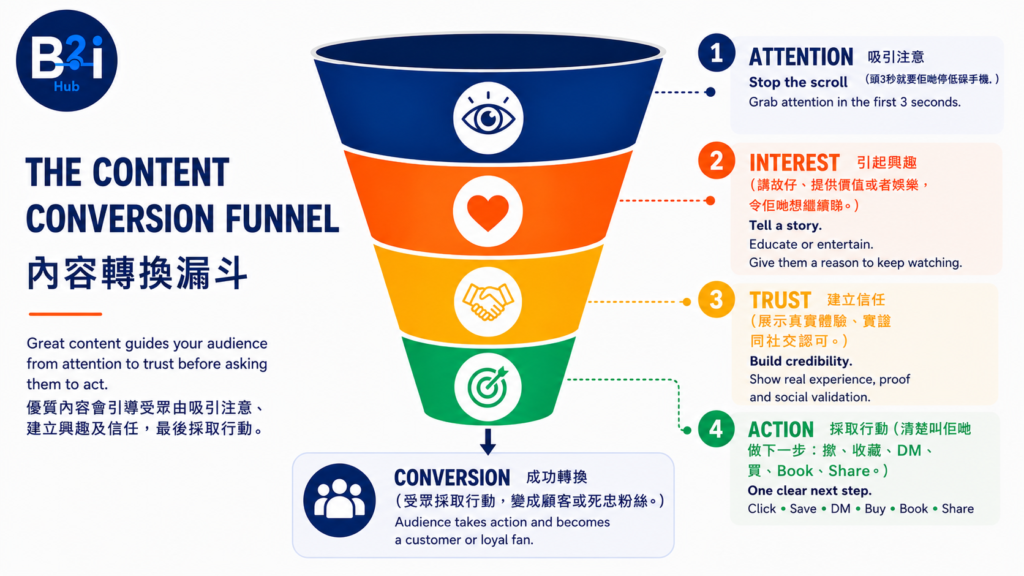
The Content Conversion Funnel: Great content doesn’t jump straight to selling. It guides audiences from attention to trust before asking them to take action.
The Modern Content Funnel
Think of successful content as a journey rather than a single post.
The strongest creators naturally guide audiences through four stages.
Attention
Stop the scroll.
Use a strong visual, surprising fact, or relatable opening.
Interest
Give people a reason to keep watching.
Teach something.
Entertain them.
Tell a story.
Trust
Demonstrate credibility.
Show real experiences.
Answer common questions.
Include proof.
Action
End with one clear next step.
Confused audiences rarely convert.
For Brands: How to Brief Creators for Conversion
One of the biggest reasons creator campaigns fail isn’t because of poor creators.
It’s because of poor briefs.
Many businesses send instructions like:
- “Post one Reel.”
- “Mention these three features.”
- “Use these hashtags.”
Technically, that’s a brief.
Strategically, it isn’t.
A great creator brief focuses on business outcomes, not simply content deliverables.
Instead of asking:
“Can you make one Instagram Reel?”
Ask:
“Can you help us encourage more first-time customers to visit our café this month?”
Notice the difference.
The first focuses on content.
The second focuses on results.
Creators can only optimise for the objective you give them.
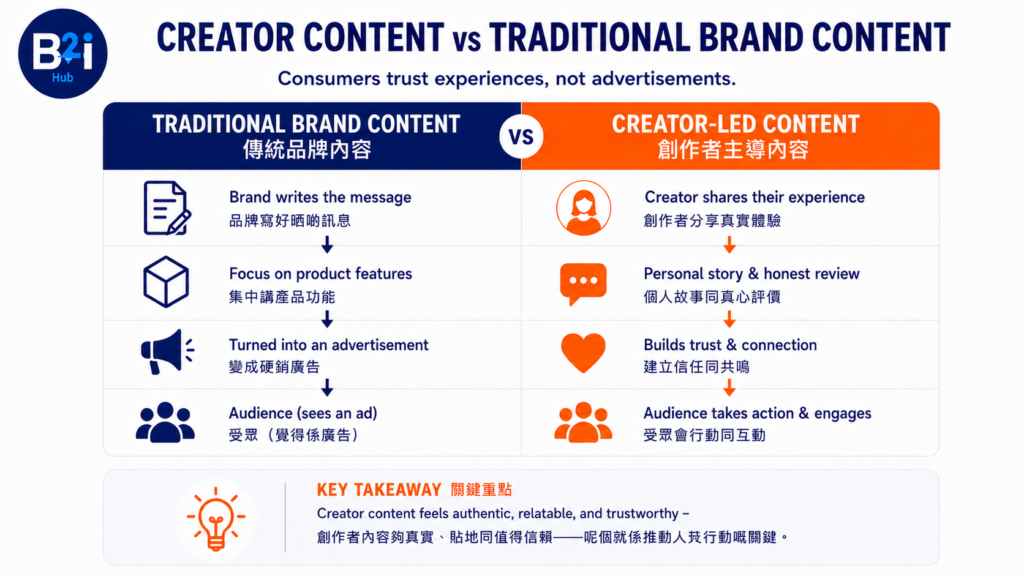
Consumers trust recommendations that feel like experiences rather than advertisements.
What Every High-Converting Creator Brief Should Include
- Campaign Objective
Be specific.
Examples include:
- Increase bookings.
- Generate enquiries.
- Build awareness.
- Collect email subscribers.
- Drive website traffic.
- Encourage store visits.
One campaign.
One primary objective.
- Target Audience
Avoid descriptions like:
“Everyone.”
Instead define:
- Age group
- Interests
- Location
- Language preference
- Lifestyle
For example:
“Young professionals aged 25–35 living in Hong Kong Island who enjoy specialty coffee and weekend brunch.”
The more clearly you define your audience, the easier it becomes for creators to speak directly to them.
- Key Message
Choose one central message.
Not five.
Not ten.
One.
If audiences remember only one thing after watching the content, what should it be?
- Creative Freedom
This is where many businesses struggle.
The temptation is to script every sentence.
Resist it.
Creators understand:
- Their audience.
- Platform trends.
- Content pacing.
- Viewer expectations.
Give them clear guardrails, not a word-for-word script.
As the creator economy matures, many brands are moving away from rigid sponsored posts and involving creators earlier in campaign planning because authentic storytelling consistently performs better than heavily controlled messaging.
- One Clear Call-to-Action
Every campaign should answer one question:
“What should viewers do next?”
Examples include:
- Visit our store.
- Book online.
- Send us a DM.
- Use this discount code.
- Save this post.
- Share with a friend.
Multiple CTAs often reduce conversions.
Keep it simple.
Common Briefing Mistakes Hong Kong Brands Still Make
Even experienced marketers occasionally fall into these traps.
Choosing Followers Over Influence
A creator with 15,000 highly engaged local followers often delivers stronger business results than someone with 300,000 passive followers.
Quality beats quantity.
Over-Scripting Every Word
Authenticity disappears when creators sound like television commercials.
Remember:
People follow creators because of their voice.
Not yours.
Ignoring Platform Behaviour
A Xiaohongshu review should not feel like an Instagram Reel.
A YouTube review should not be edited like a Facebook post.
Each platform has its own culture, expectations, and audience behaviour.
Successful campaigns adapt accordingly.
Measuring Only Views
The best-performing campaigns often aren’t the most viewed.
Instead, evaluate:
- Saves
- Shares
- Comments
- Website clicks
- Store visits
- Direct messages
- Purchases
These metrics reveal whether your content is actually influencing behaviour.
By creating better briefs, brands give creators the freedom to produce content that feels authentic while remaining focused on clear business outcomes.
The result isn’t simply better content.
It’s content that converts.
For Creators: How to Create Content That Drives Action
Being a successful creator in 2026 is about much more than producing beautiful photos or editing cinematic videos.
Brands are increasingly asking a different question:
“Can this creator influence decisions?”
That doesn’t mean convincing people to buy something they don’t need.
It means creating content that helps audiences feel informed, confident, and ready to take the next step.
The most successful creators don’t sell products.
They solve problems.
Whether you’re reviewing a new café in Causeway Bay, showcasing a fitness studio in Tsim Sha Tsui, or introducing a local skincare brand, your audience is looking for one thing above all else:
Honest guidance.
If they trust your opinion, they’ll often trust your recommendation.
A Simple Formula for High-Converting Content
While every platform is different, many high-performing posts follow a similar structure.
Step 1: Grab Attention Immediately
The first three seconds determine whether someone keeps watching or scrolls away.
Instead of opening with:
“Today I’m reviewing this café…”
Try:
“I think I just found one of the most underrated brunch spots in Hong Kong.”
Or:
“Would you queue 30 minutes for this croissant?”
Curiosity encourages viewers to stay.
Step 2: Tell a Story
Facts inform.
Stories persuade.
Instead of listing product features, explain:
- Why you tried it.
- What problem you wanted to solve.
- What surprised you.
- Whether it met your expectations.
People remember experiences far more than specifications.
As the Cantonese saying goes:
「有故事先有人聽。」
People listen when there’s a story.
Step 3: Show, Don’t Just Tell
Whenever possible, demonstrate the experience.
Instead of saying a coffee tastes great, show:
- The latte art.
- The café atmosphere.
- The first sip.
- Customer reactions.
- The environment.
Visual proof builds confidence.
This is especially important on Instagram Reels, Xiaohongshu, and YouTube Shorts, where audiences expect to see experiences rather than simply hear about them.
Step 4: Add Social Proof
Consumers naturally feel more confident when they know others have had positive experiences.
Examples include:
- Customer reviews.
- Busy cafés.
- Before-and-after results.
- User testimonials.
- Awards.
- Repeat visits.
Even subtle social proof can significantly strengthen credibility.
Step 5: End With One Clear Action
Never assume viewers know what to do next.
If you want them to:
- Save the post
- Visit the café
- Check the website
- Send a message
- Share with friends
Simply tell them.
A clear call-to-action removes uncertainty.
Authenticity Doesn’t Mean Avoiding Promotion
Some creators worry that sponsored content automatically feels inauthentic.
In reality, audiences don’t dislike advertising.
They dislike advertising that feels dishonest.
The difference is important.
A creator can openly say:
“This video is sponsored, but these opinions are my own.”
Most audiences appreciate transparency.
On the other hand, pretending a paid partnership isn’t sponsored can quickly damage trust.
The strongest creator-brand relationships are built on honesty.
Promote products you genuinely believe in.
Decline partnerships that don’t align with your audience.
Remember:
Your reputation is your most valuable asset.
The 5 Elements of High-Converting Content
Before publishing your next post, run through this quick checklist.
- A Clear Hook
Could someone understand why they should keep watching within the first three seconds?
Examples include:
- A surprising statistic.
- A bold opinion.
- A relatable problem.
- A strong visual.
If the opening doesn’t capture attention, the rest of the content may never be seen.
- A Relevant Audience
Not every piece of content is for everyone.
Ask yourself:
Who am I speaking to?
Young professionals?
Parents?
Fitness enthusiasts?
Food lovers?
The more specific your audience, the stronger your message becomes.
- An Emotional Connection
People remember how content makes them feel.
Use emotions such as:
- Curiosity.
- Inspiration.
- Relief.
- Excitement.
- Nostalgia.
These emotions encourage sharing and discussion.
- Trust Signals
Support your message with evidence.
Examples include:
- Personal experience.
- Customer feedback.
- Demonstrations.
- Transparent reviews.
- Honest comparisons.
Trust is earned through consistency rather than exaggeration.
- One Strong Call-to-Action
Avoid overwhelming your audience with multiple requests.
Choose one primary action.
Examples:
- “Save this for your next weekend.”
- “Book through the link in our bio.”
- “DM us for today’s promotion.”
- “Share this with someone planning a trip to Hong Kong.”
Simple, direct calls-to-action often outperform complicated messaging.
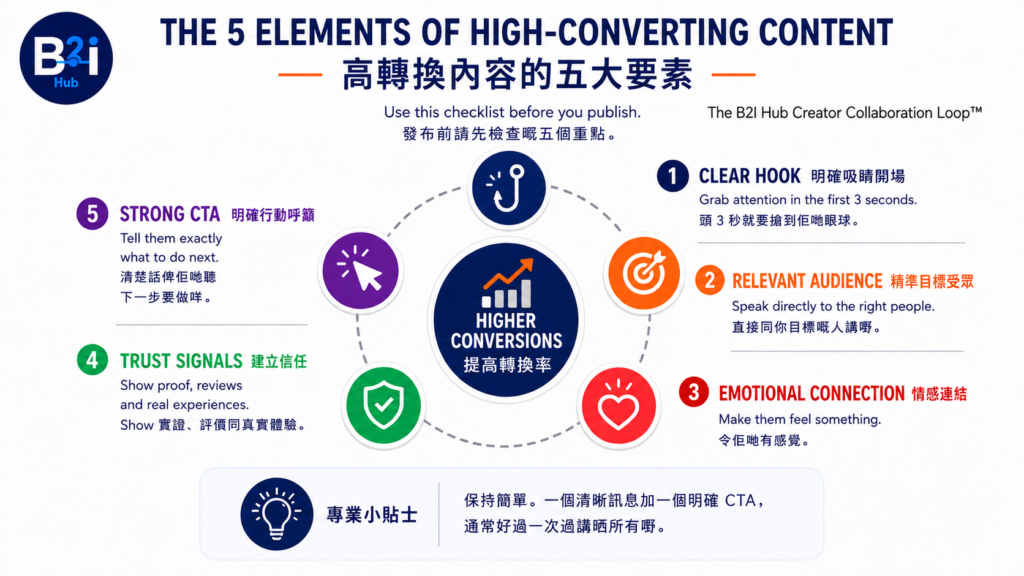
The 5 Elements of High-Converting Content — a quick checklist before you publish.
Platform-Specific Tips for Hong Kong
Every platform has its own audience behaviour.
Understanding these differences helps content perform more effectively.
Instagram Reels
Instagram remains one of Hong Kong’s strongest discovery platforms for lifestyle, fashion, food, beauty, and hospitality brands.
Best practices include:
- Capture attention within three seconds.
- Use fast editing.
- Add subtitles.
- Show people rather than products.
- End with a clear CTA.
Short, visually engaging content tends to perform best.
Xiaohongshu (Little Red Book)
Hong Kong users increasingly rely on Xiaohongshu for product research, restaurant recommendations, travel inspiration, and beauty advice.
Successful posts typically include:
- Detailed explanations.
- Honest reviews.
- Useful comparisons.
- Practical tips.
- High-quality photography.
Think of Xiaohongshu as a search engine powered by personal experiences.
People visit the platform to learn before they buy.
YouTube
Longer videos allow creators to build deeper trust.
Ideal content includes:
- Product reviews.
- Tutorials.
- Behind-the-scenes content.
- Interviews.
- Travel guides.
- Educational videos.
Viewers often arrive with higher purchase intent because they’re actively researching.
Facebook and WhatsApp
Despite newer platforms attracting attention, Facebook remains important for many Hong Kong communities, neighbourhood groups, and SMEs.
WhatsApp also plays a unique role in customer communication.
Content that performs well includes:
- Local updates.
- Community news.
- Event announcements.
- Customer testimonials.
- Conversational videos.
Rather than polished advertising, these platforms reward familiarity and responsiveness.
Measuring What Actually Works
If you only measure likes, you’re missing the bigger picture.
Instead, evaluate content using metrics aligned with your business goals.
Track:
- Website visits.
- Link clicks.
- Profile visits.
- Saves.
- Shares.
- Direct messages.
- Bookings.
- Purchases.
- Email sign-ups.
- Returning customers.
Review results regularly.
Ask:
Which posts generated conversations?
Which videos encouraged people to visit our website?
Which creators consistently drove enquiries?
Data should guide future content decisions.
The goal isn’t to create more content.
It’s to create smarter content.
Content That Converts Is Built Through Testing
Even experienced marketers rarely produce perfect content every time.
High-performing brands constantly experiment.
They test:
- Different hooks.
- Different thumbnails.
- Different captions.
- Different CTAs.
- Different creators.
- Different publishing times.
Small improvements accumulate over time.
The businesses that consistently learn from their analytics often outperform competitors with much larger marketing budgets.
Final Thoughts
Creating content that converts isn’t about chasing viral moments or copying the latest social media trend.
It’s about understanding people.
When content educates, entertains, builds trust, and gives audiences a clear reason to act, conversions become a natural outcome rather than a matter of luck.
For Hong Kong brands, this means investing in authentic storytelling instead of simply increasing advertising spend.
For creators, it means building credibility through consistency, transparency, and genuine recommendations.
Whether you’re promoting a family-run café in Sham Shui Po, launching a new fashion label in Central, or growing your own creator business, the same principle applies:
The best content doesn’t just get attention—it inspires action.
For a deeper look at why Hong Kong brands are making the shift to creator-led marketing, read our guide on creator-led marketing in 2026.
How B2I Hub Helps Brands and Creators Succeed
Creating content that converts starts with finding the right partner.
Brands need creators who understand their audience.
Creators need businesses that value creativity rather than treating content as just another advertisement.
That’s exactly what B2I Hub was built to do.
B2I Hub connects Hong Kong businesses directly with local micro-creators, making it easier to discover talent, build long-term partnerships, and collaborate without agency commissions or unnecessary middlemen.
Whether you’re an SME looking to launch your first creator campaign or a creator searching for meaningful brand collaborations, B2I Hub helps turn great ideas into content that delivers real business results.
Because at the end of the day, successful marketing isn’t measured by how many people see your content.
It’s measured by what they do next.
Key Takeaways
- Content that converts always has a clear objective
- Storytelling is more persuasive than simply listing product features
- Authenticity builds trust—and trust drives action
- Each platform requires a different content strategy
- Measure business outcomes, not just likes and views
- Test, learn, refine, and improve consistently
- The best brand-creator partnerships focus on long-term value, not one-off campaigns
- With the right strategy and the right collaborators, even small Hong Kong businesses can create content that competes with much larger brands
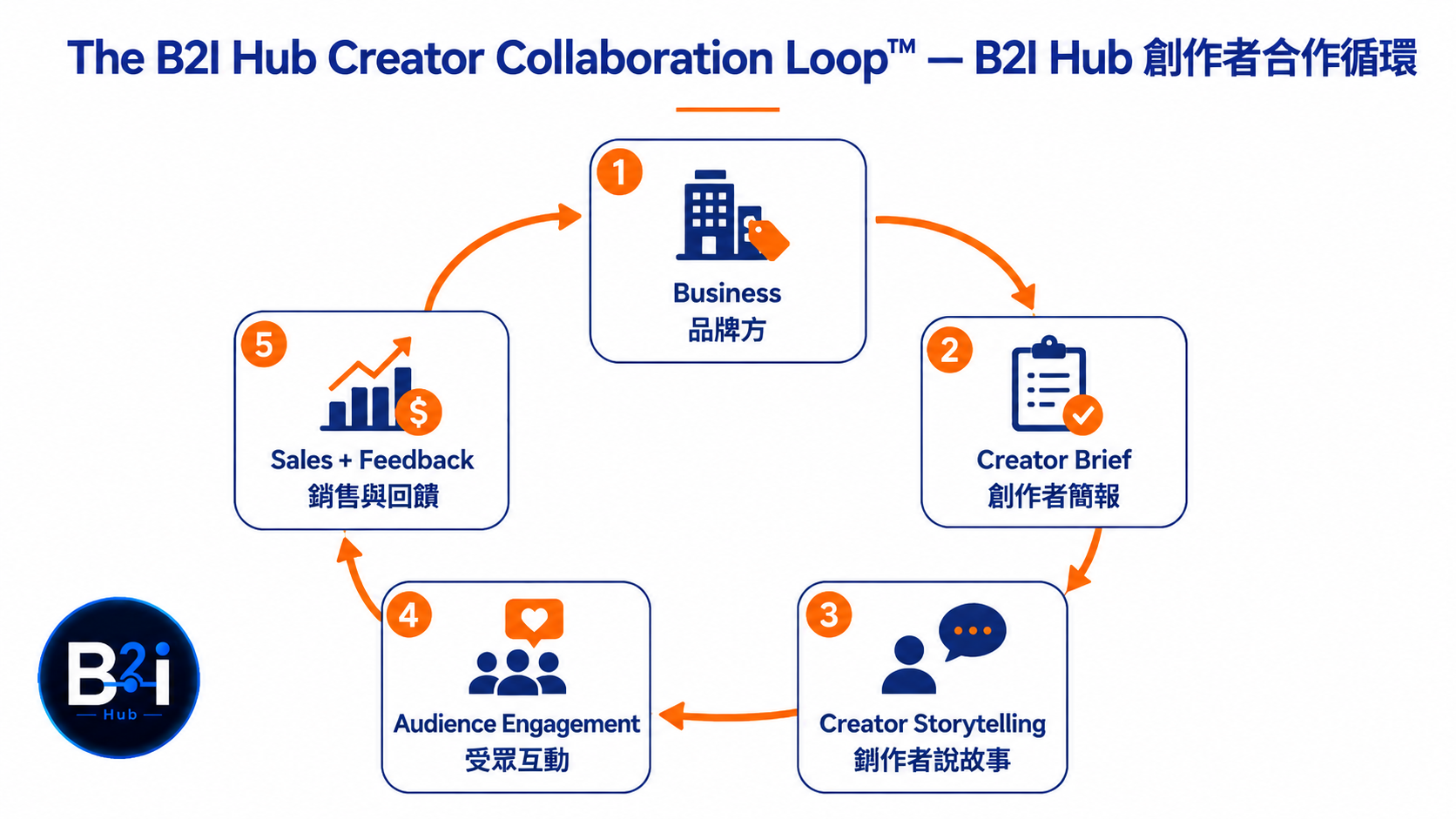
The B2I Hub Creator Collaboration Loop™ — a framework for long-term brand-creator partnerships.